Unfortunate Realities on the Colorado River
A personal essay on Lake Powell and the surrounding towns of Big Water, UT and Page, AZ.
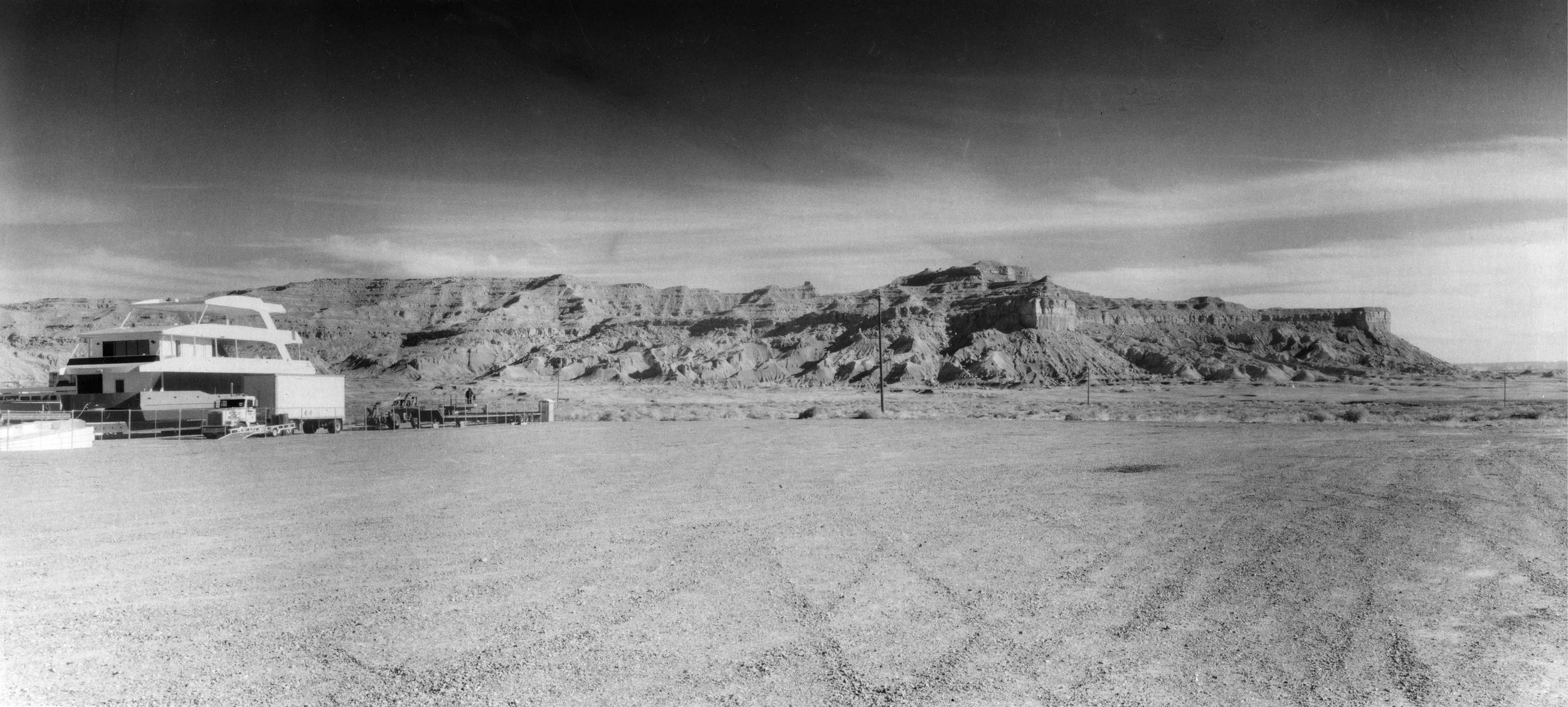
Looking northeast from Big Water, Utah to the Kaiparowits Plateau. December 15, 2025
I saw this boat in Big Water, Utah when I first passed through in December 2025. It was impossible to not notice it, there isn’t much else to see in the town and the distant cliffs of the Kaiparowits Plateau can only hold the eyes so long. I drove past initially, thinking how ridiculous and out of place it was, but something compelled me to turn around and take a photo.
Southern Utah and Northern Arizona are sparsely populated, a product of the harsh environment in the area. The air wicks the moisture out of your pores, leaving you parched and blisteringly aware of the sun’s directness. The brilliant blue of the sky highlights the almost total absence of clouds. The plants are short, stubby things like sagebrush, ephedra and junipers. The rivers through the area are mostly small streams that would be called creeks in even Northern Utah or Colorado. The only reason such a large boat could exist here is the Colorado River, specifically Lake Powell.
I hadn’t seen Lake Powell myself yet, it was always a little too far for previous trips. But, after slipping and injuring my left thumb outside Escalante, Utah badly enough it needed to be wound up for a couple weeks, the time seemed right to finally visit the lake.
I stopped in Kanab, Utah for a night, leaving early the next morning for Page, Arizona. The suburban sprawl from Kanab slowly dwindled to individual cabins, then eventually to plains of sagebrush and hills of Bentonite clay. Except for the road and the barb wire fences running on either side, there was only the vastness of the cliffs, basins and sky. Soon, though, signs of development reappeared. The occasional small house soon gave way to RV parks and storage warehouses, proudly advertising their ties to Lake Powell. As I entered Big Water, I expected to see more of the same.
Without the lake, most of the towns here would be substantially smaller or non-existent. Page was founded in 1957 as worker housing for the construction of Glen Canyon Dam, and just so happened to stick around since then. Big Water was founded initially as Glen Canyon City in the 1950s, also to help with construction of the dam, before eventually being renamed and incorporated in 1983. Since then, both have been inextricably tied to the reservoir, with their economies dependent almost entirely on the tourists who visit the area.
Lake Powell sits in the deep, labyrinthian maze of the Glen Canyon region. The reservoir started filling up in March 1963, reaching full capacity in 1980. It is massive, clocking in at 186 miles long at its peak in the 1980s; it’s the second largest reservoir in the U.S. after downstream Lake Mead. Both reservoirs were built as water storage projects for the states in the Colorado River Basin. Mead supplies water and power to Arizona, California and Nevada; Powell supplies to Colorado, New Mexico, Utah and Wyoming.
But there’s an issue with these reservoirs, as both are at critically low levels. Lake Mead, responsible for storing the water that grows the bulk of the United States’ winter produce, sits at 30% of capacity at time of writing. Lake Powell, a major economic driver for southern Utah’s and northern Arizona’s tourism-based economies, sits at 23% of capacity at time of writing. If Lake Powell continues to drop, it will quickly reach two points: power pool, where the dam’s turbines no longer generate electricity, then dead pool, where water can no longer flow past the dam’s river outlet works. This would cripple the Colorado River Basin’s water supply and demand immediate corrective action to ensure Lake Mead remains usable.
The prolonged drought in the Colorado River Basin has revealed the issues with 1922 Colorado River Compact. It overestimated how much water the river would have during normal and drought conditions, with Lee’s Ferry Averaging 12.9 million acre-feet of water from 2004-2024, 21.8% short of the compact’s 16.5 million acre-foot basin allocation. Lake Mead will likely last, due to its importance. But, despite efforts by water managers in the basin, Lake Powell will probably not survive the decade, with the U.S. Bureau of Reclamation claiming that without intervention, the reservoir would reach power pool by August 2026.
On May 8, 2026, the Bureau of Reclamation announced an emergency release from Flaming Gorge Reservoir on the Green River. It will run through April 2027 and allow between 660-thousand and one million acre-feet of water to flow downstream to beleaguered Lake Powell. The goal of this release is to prop up the reservoir, buying time for a plan to keep water flowing to Lower Basin states.
It was known to locals even before the release had been announced that the system was on the brink of collapse. As I grabbed food at the now defunct State 48 Tavern in Page, Arizona in mid-December, I made conversation with two mechanics from the boat yards. The first, a middle-aged Ohioan who had bounced around, living in Atlanta, Georgia for a while before heading out west, remarked on how beautiful the stars were. He didn’t talk much about the dam, no doubt because he’d been there less than a year. His concern for endings was more that the pub we were in would be closed by the end of the next month.
The other mechanic was a younger man and had been there a few years. He was more aware of the realities surrounding Powell. It was clear to him that the reservoir was declining into obsoletion. He explained his position that the job he was working would be gone before long, and so he was working one of his last seasons before living on his sailboat in the Pacific Ocean for a while. No amount of water reallocation or conservation would reverse the inevitable, but he could make enough money for his own personal project to go ahead before he left.
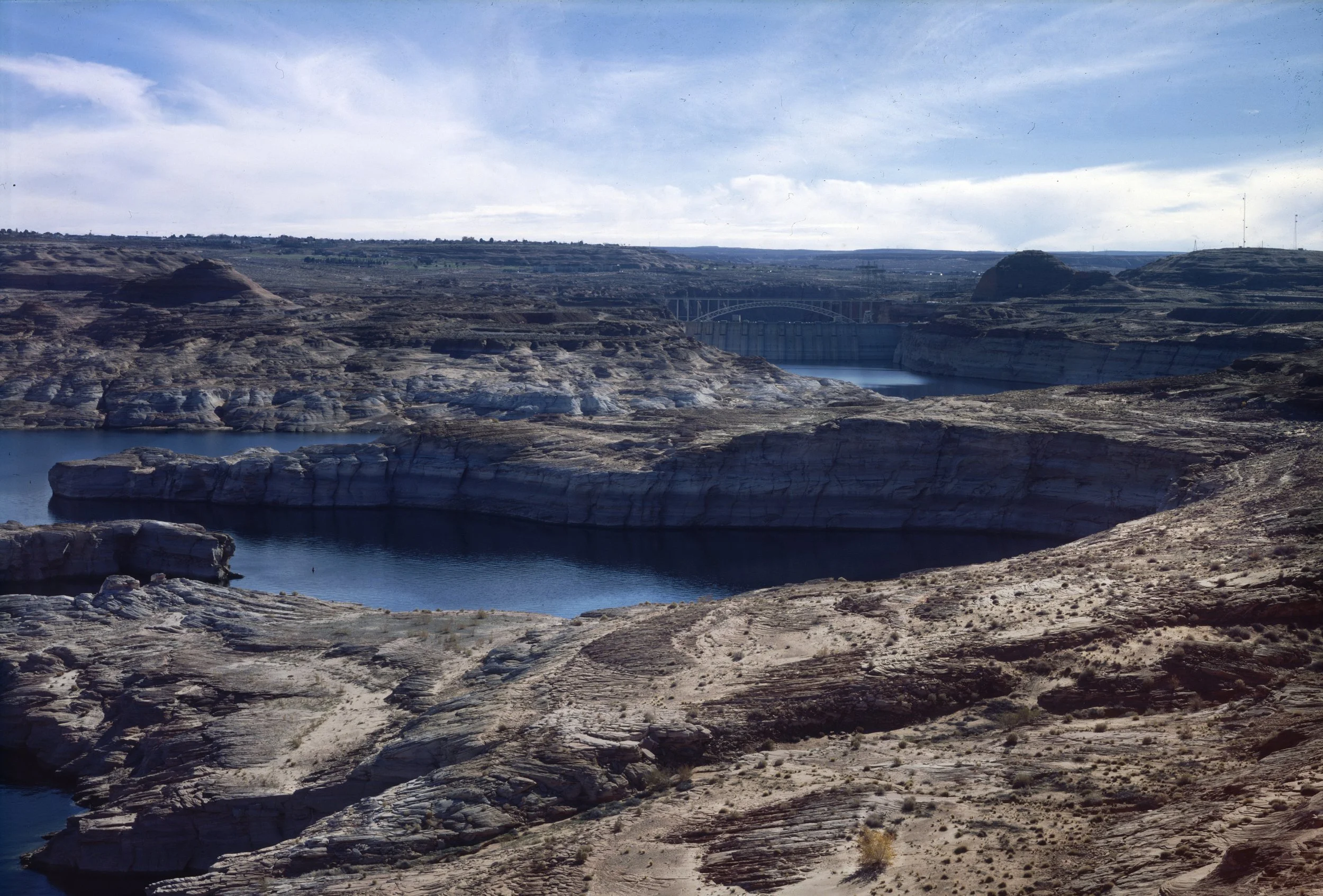
The low water levels on Lake Powell reveal the bathtub ring, where past high water lines have bleached the red of the cliffs. December 15, 2025
Earlier that day, it became clear as I approached Lake Powell how diminished it was from the highs of 40 years ago. At Lone Rock Beach, the water that once was clearly visible from the public showers was a mere sliver, not even reaching the area’s namesake butte. Towards the dam, there was a clear white line on the walls over a hundred feet high, a bathtub ring formed by the water that bleached the once red sandstone cliffs of the Colorado River. At the Wahweap area, all public boat launches but the Stateline Auxiliary Launch Ramp have been closed since August 18, 2025.
My choice earlier in the day to photograph that boat was made on a whim, I felt there was something symbolic about a houseboat in the barren plains of the Glen Canyon region. It now represents a stubborn resistance to the realities of a changing world, born not out of persistence but of an ignorance of our environment. This shift is occurring irrespective of the wishes of any one person or group of people, and the time to prevent it has largely slipped. Now we can only hope to learn from it and allow the natural world to reclaim what rightly belongs to it. The future may seem bleak, but it is what we have to work with. And under Lake Powell lies canyons and a choice to reflect on decades of false assumptions about our collective place within the world.
